How to work out required pile depth and length from CPT data
There is no single formula behind a pile depth calculator. The depth a pile needs is the depth at which its capacity meets your design load, and with CPT data that capacity can be computed at every possible tip depth. Choosing a pile length then becomes reading a chart from a free CPT capacity calculation.
Step 1: Know your required load
Start from the structural load the pile must carry and apply the load and capacity factors your design code requires (in Australia, AS 2159). That gives the geotechnical capacity the pile must provide. This part stays with the design engineer; the calculator handles the next part.
Step 2: Run a CPT-based capacity calculation
Upload the CPT trace from your site investigation to one of the free UWA calculators: driven piles (Unified CPT method, Lehane et al. 2020), bored and CFA piles (Doan & Lehane 2021), or screw piles (Bittar et al. 2023). Each method builds the pile's shaft friction and base resistance directly from the measured cone resistance, rather than from generic soil-type assumptions.
Step 3: Read the depth off the capacity vs depth plot
The driven and bored pile results include a plot of axial capacity against pile tip depth, in compression and in tension:
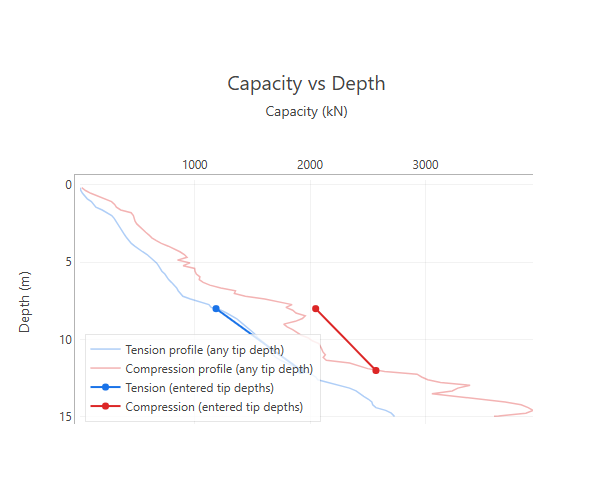
Capacity generally grows with depth as shaft friction accumulates, so the required pile length is the depth where the capacity curve crosses your required value. If the pile also resists uplift, check the tension curve the same way; tension capacity is usually the lower of the two, so read it off the plot rather than assuming a fraction of the compression value.
The screw pile calculator reports capacity at the helix depth you enter, so there you run trial depths instead of reading a curve.
What to watch for
- Layered ground. Capacity does not always rise smoothly. Where the CPT shows a weak layer, the curve flattens or dips, and a tip founded just above a weak layer can be misleading. Look at the whole profile, not just the crossing point.
- CPT depth limits. Capacity can only be computed where soil data exists, so the CPT must extend below any tip depth you are considering. The calculator will refuse tip depths below the deepest CPT reading rather than guess.
- Groundwater. The water table affects vertical effective stress and therefore capacity. The calculators build the stress profile from the unit weights and water table depth you provide, so enter them with care.
- Settlement and lateral demands. Axial capacity is usually the starting point, but stiffness, settlement or lateral loading can govern. The other UWA modules cover footings, monopiles and retaining walls.